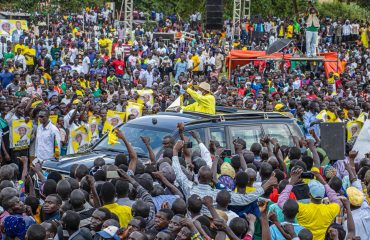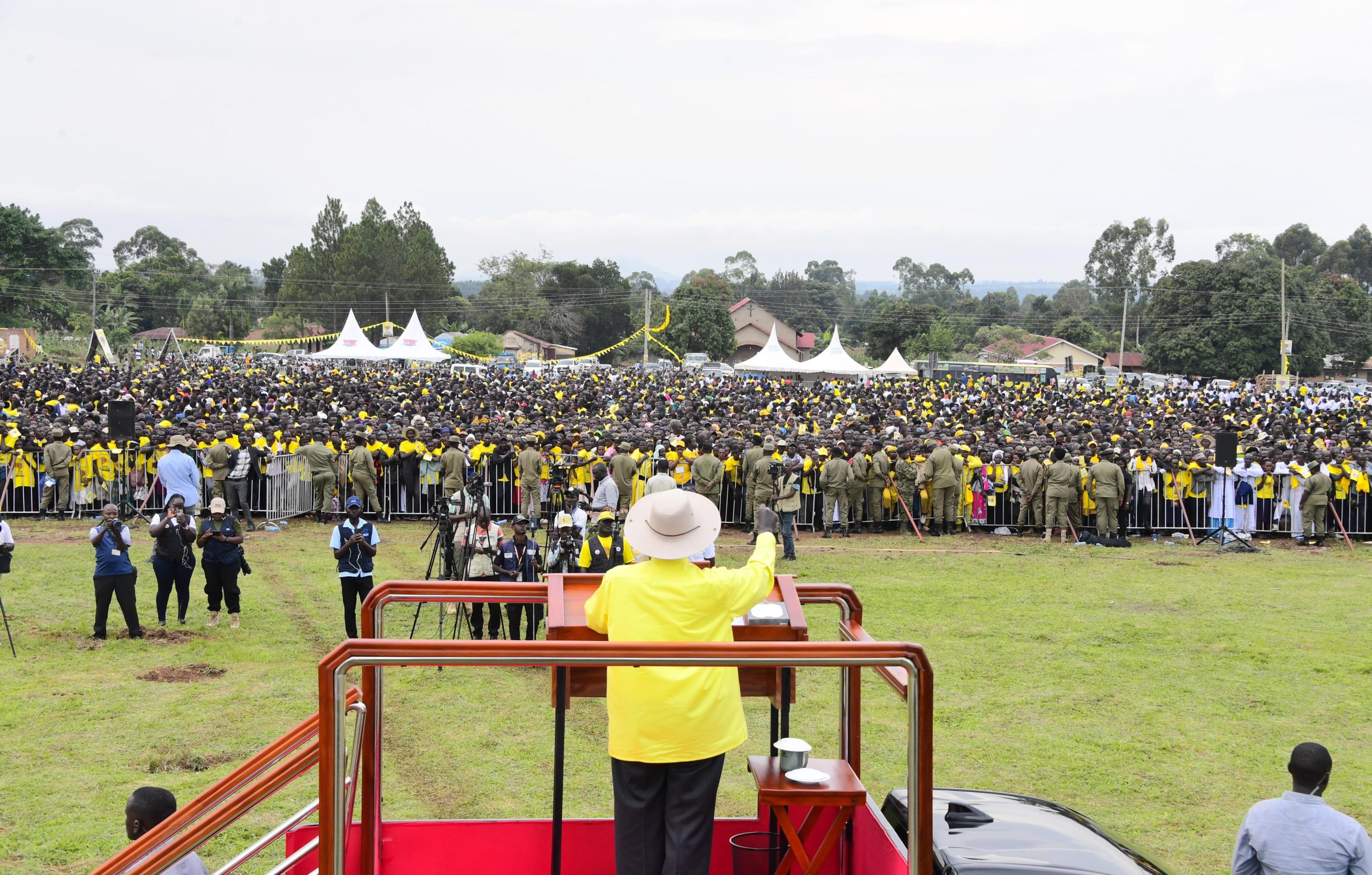
Bunyoro sub-region with major pledges centered on industrialisation, infrastructure development, wealth creation, and the sustainable use of Uganda’s oil resources. Accompanied by the First Daughter, Mrs. Natasha Museveni Karugire, senior NRM leaders and Cabinet ministers, the President traversed Kibaale, Kiryandongo, Masindi, Buliisa, and Hoima districts where he addressed thousands of enthusiastic supporters ahead of the 2026 general elections.
Across the sub-region, President Museveni reiterated the National Resistance Movement’s (NRM) core achievements over the last 40 years: peace, development, wealth creation, and job generation, emphasising that the next term will focus on consolidating these gains while expanding economic opportunities for households.
In Kibaale District, President Museveni unveiled one of the biggest commitments: a new industrial park and a second regional skilling hub to accelerate manufacturing and youth empowerment in Bunyoro.
Addressing supporters at Buyanja Village, the President emphasised that industrialisation is key to creating jobs, expanding markets, and increasing the value of local products. He said Kibaale deserves an industrial park beyond the petroleum-oriented Kabalega Industrial Park already in Hoima.
“We need about 10 square miles for the industrial park, and we shall get it,” he assured. Local leaders confirmed that 110 acres have already been secured for the project.
The President also encouraged households to embrace the four-acre model, showcasing success stories of farmers like Ms. Deziranta Tumusime of Rubirizi and Mr. Johnson Basangwa of Kamuli whose incomes have grown after adopting NRM-guided enterprise systems and receiving PDM funds.
In Kiryandongo, President Museveni addressed a massive crowd at Karagalya Grounds and commended the district for its rapid transformation over the years. He highlighted significant investments in roads, schools, electricity, and the agricultural sector, calling Kiryandongo a “model district for NRM’s development agenda.”
The President urged households to scale up commercial agriculture, especially dairy, coffee, fruits, banana cultivation, and fish farming. He restated that household wealth must now match public investments.
“Government will continue delivering infrastructure, but families must also use their land to create wealth,” he said.
The President further reassured residents that the next term will emphasise: completion of ongoing road works, expansion of electricity coverage, scaling up PDM implementation, youth skilling and job creation.
In Masindi Municipality, President Museveni addressed residents’ long-standing concerns over stalled urban development. He pledged that Masindi will be among the first beneficiaries of the upcoming Uganda Cities and Municipalities Infrastructure Development Programme, set to begin in 2026.
The programme will deliver modern markets, improved roads, and strengthened municipality infrastructure services Masindi missed under earlier USMID phases.
The President also issued directives to address systemic land grabbing and ordered urgent enforcement of the Sugar Act, following complaints of exploitation of out-growers. He announced that government will provide additional tractors for mechanisation and deliver a new ferry on Lake Albert to improve trade between Masindi and neighbouring districts.
On service delivery, President Museveni confirmed plans to upgrade four Health Centre IIs to Health Centre IIIs and construct new facilities in underserved sub-counties. He also committed to expanding rural safe-water access, noting that over 220 villages still lack clean water.
He urged residents to separate development (public infrastructure) from wealth creation (household income), arguing that prosperity requires families to adopt profitable enterprises.
In Buliisa District, one of Uganda’s oil epicenters, President Museveni delivered a strong message on the responsible management of petroleum revenues. He said Uganda’s 6.5 billion barrels of recoverable oil, expected to be extracted for about 25 years, must not be treated as everyday income.
“We must use petroleum to create durable wealth. Oil is exhaustible, but agriculture and enterprise can sustain us forever,” he said.
The President pledged government dialogue and support for Lake Albert fishing communities, acknowledging the harsh impact of illegal fishing crackdowns. He directed the UPDF Fisheries Protection Unit to return confiscated boats, engines, and motorcycles, excluding banned fishing nets.
He also emphasised that industrialisation will be a key job creator, citing Namanve, Kapeka, Mbale, and Kakira industrial parks as examples of government-led transformation.
He encouraged residents to adopt the four-acre model, highlighting results from demonstration farms like Minister Byamukama’s in Kakumiro and his own Barlege Model Farm in Lango.
Buliisa now has 61,122 registered voters, up from 44,869 in 2021, a growth the President said shows increasing civic engagement.
In Hoima City at Booma Grounds, President Museveni highlighted major development achievements, citing improved roads, expanded telecommunication coverage and rapid rural electrification. He noted that 12 of the 14 Sub-counties/Town Councils in Hoima are already connected to the national grid, with Kiganja and Kijongo planned for the next term.
On social infrastructure, he reported that Hoima district now has 64 government primary schools and 6 government secondary schools, while Hoima City has 33 government primary schools and 5 government secondary schools, each offering Universal Secondary Education and the UPOLET programme.
He further pointed to the ongoing construction of four seed schools and upgrades in the health sector, including ICU services, radiology improvements and the oxygen plant at Hoima Regional Referral Hospital.
President Museveni stressed that development must translate into household wealth. He encouraged families to embrace commercial agriculture and large-scale farmers to invest in tea, ranching and cotton.
The President announced that, apart from Kabalega Industrial Park for petroleum-related industries, government will establish a separate industrial park dedicated to agro-processing. He also noted that job creation would come from agriculture, factories, services and ICT.
Throughout the tour, the President has been joined by top NRM leaders including the Speaker of Parliament Rt. Hon. Anita Annet Among, Prime Minister Rt. Hon. Robinah Nabbanja, NRM Secretary General Rt. Hon. Richard Todwong, NRM Central Executive Committee Members, NRM Electoral Commission Chairperson Dr. Tanga Odoi, and regional leaders.
The Speaker of Parliament and NRM’s 2nd Vice Chairperson, Rt. Hon. Anita Among thanked the President for sustained investments in Bunyoro and urged voters to support the NRM, noting that development funds are allocated by the sitting government. She also backed calls for modern markets in Masindi and other town councils.
As the President comes to a conclusion of his campaigns in the Bunyoro sub-region, he reaffirmed that Bunyoro remains a central pillar in Uganda’s economic future, especially with ongoing oil and gas developments, expanded industrialisation plans, and modernising agriculture.
He urged residents to support him and all NRM flagbearers in the 2026 elections, saying the next term will prioritise: consolidating peace, completing large infrastructure projects, expanding the industrial base, strengthening wealth and job creation models, and ensuring transparency in PDM and government programmes.
“Peace brought development; development must now bring wealth,” the President reminded supporters.
President Museveni’s campaigns continue in other sub-regions as he seeks a new mandate for the 2026–2031 term.
Written by
Joellah Anshemeza
Communications Officer, GCIC-State House.